Michigan State University researchers and faculty members received Undergraduate Research Mentor of the Year and Supervisor of the Year Awards for their dedication to student research excellence.
Dr. Younsuk Dong, assistant professor in the Department of Biosystems and Agricultural Engineering in the College of Agriculture and Natural Resources and College of Engineering, and Dr. Bridget Walsh, associate professor in the College of Communication Arts and Sciences’ Department of Communicative Sciences and Disorders, received the Undergraduate Research Mentor of the Year Award at the 2026 University Undergraduate Research and Arts Forum (UURAF) on April 17.
Dr. Franziska Maria Maier, research associate at the Facility for Rare Isotope Beams at MSU, earned the Undergraduate Research Supervisor of the Year Award.
Undergraduate Research Mentor of the Year and Supervisor of the Year Award winners are nominated by undergraduate student researchers. The awards recognize faculty, staff, graduate students and other research mentors for their commitment to undergraduate researcher mentorship and their impact on undergraduate research experiences.
Undergraduate Research Mentor of the Year: Younsuk Dong
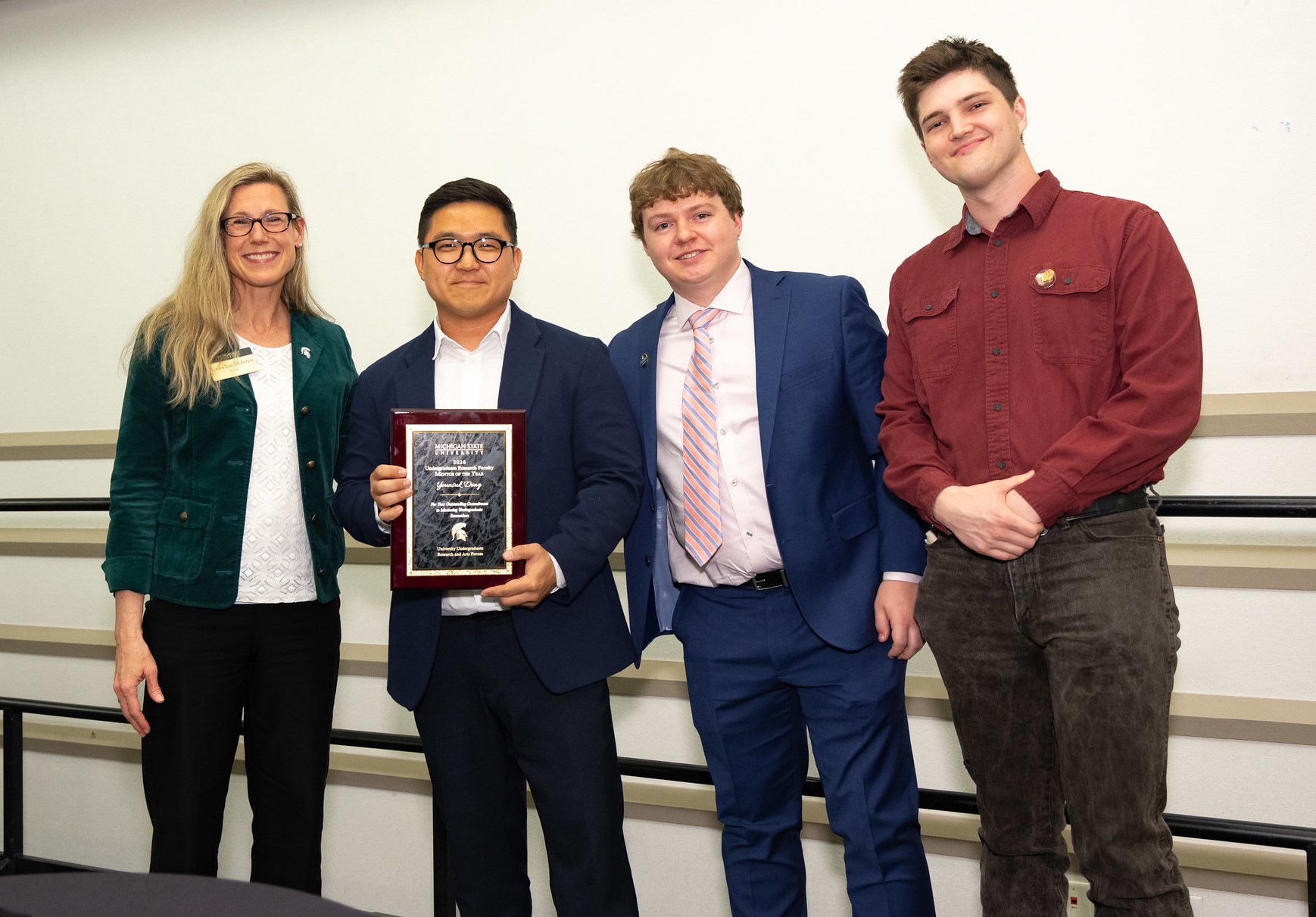
Dr. Younsuk Dong’s irrigation research aims to help farmers increase crop production while using water and energy efficiently.
His work combines irrigation technologies with water management practices to reduce resource use, protect water supplies and support long-term agricultural resilience.
Undergraduate students who Dong mentors play an important role, contributing through field experiments, data processing, laboratory analyses and technology development.
One student nominator joined Dong’s research efforts after a previous internship was canceled, gaining valuable experience learning about sensors, fabrication, field implementation and practical skills. This opportunity reflects Dong’s commitment to growing students as researchers and professionals.
Students entering Dong’s mentorship do more than observe and follow his direction; he develops them into independent researchers.
He currently mentors seven undergraduate students. Effective mentorship, he said, starts with open and approachable communication. Dong strives to create a research environment where students feel comfortable sharing ideas, discussing challenges and asking questions. Rather than giving students answers, he challenges them to analyze problems, consider different approaches and make informed decisions.
“Ultimately, my goal is to help students develop into independent, confident researchers while ensuring they know I am always available to support them along the way,” he said.
While Dong works to develop students into independent researchers, he ensures they work as a team, not as individuals working in isolation.
As part of their research experience, students have their own individual research projects, but regularly collaborate, assisting each other with work like technology development and troubleshooting. It’s an approach that allows students to learn from each other and address larger and more complex research questions.
Dong further emphasizes teamwork and community through weekly lab meetings, monthly lab lunches and activities outside the lab, giving students additional opportunities to connect and grow.
These mentorship opportunities help students participate in meaningful research and achieve long-term goals.
Through their experience in Dong’s research program, one student nominator became the only undergraduate presenter at the Great Lakes Fruit Workers Conference and now is working toward publication as the first author on a manuscript. The student was encouraged to present at additional conferences and was recently accepted to medical school.
“While he may be an engineering faculty member, and I want to be a physician, he has shown me how to care for people, how to patiently listen, and how to positively provide feedback and information,” the student wrote. “Dr. Dong has taught me invaluable lessons in research, problem solving, resilience, and teamwork.”
For Dong, receiving this award recognizes not only his efforts, but the hard work and dedication to research of his students and collaborators. He shares a dedication to mentoring the next generation of researchers and working with them to advance innovative irrigation research.
“The most rewarding part of mentoring is seeing students grow into independent researchers and future leaders,” Dong said. “It is exciting to watch them build confidence, develop new skills, and realize they can solve complex problems that have real-world impacts.”
Undergraduate Research Mentor of the Year: Bridget Walsh
Dr. Bridget Walsh’s research focuses on the development of stuttering in children and the factors that shape its long-term impact, with the goal of improving early identification and intervention.
Using clinical, behavioral, neurophysiological and psychophysiological approaches, Walsh’s lab investigates why some children outgrow stuttering while others continue to stutter.
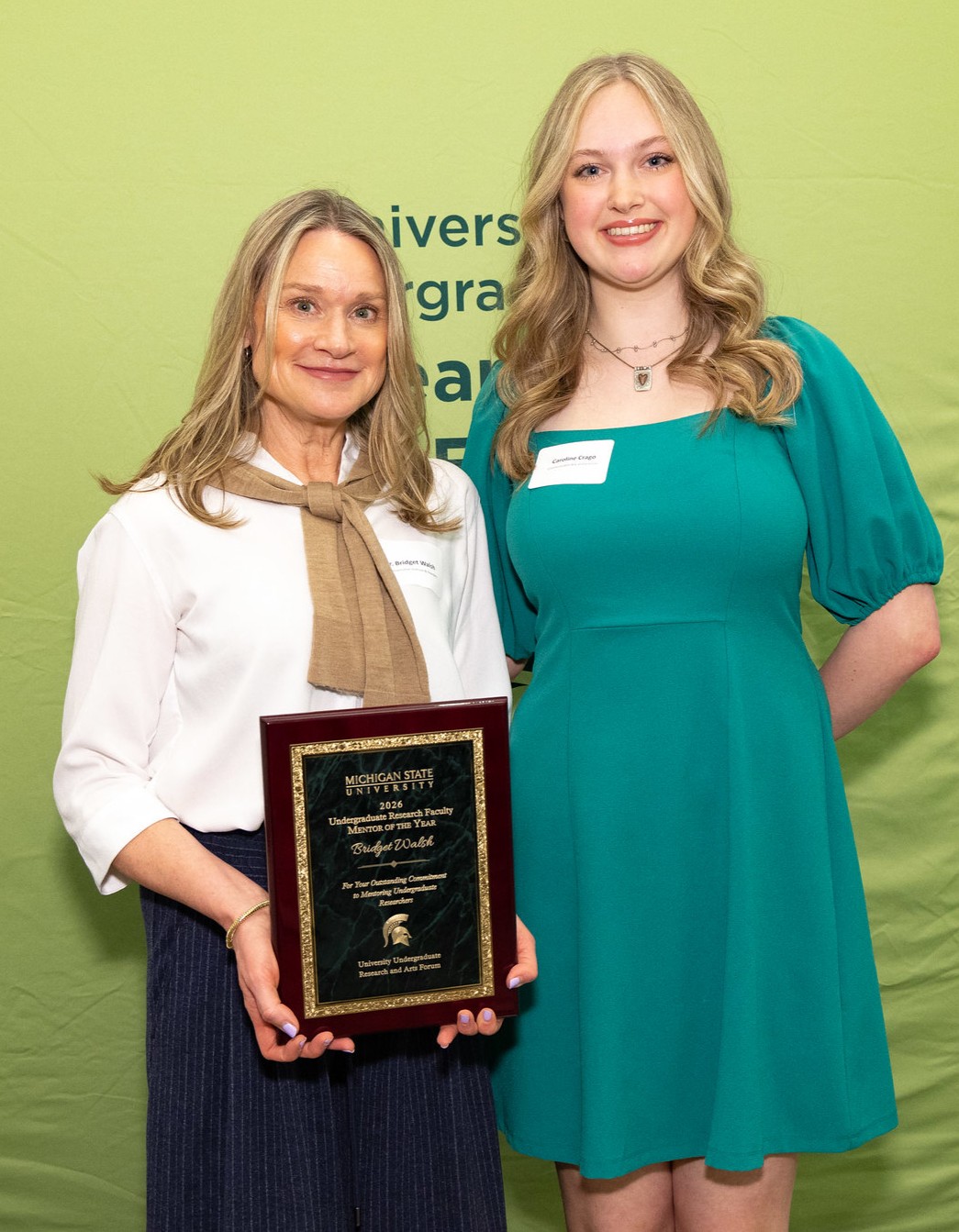
Walsh mentors students at all levels — high school, undergraduate, graduate and postgraduate.
Students’ research involvement depends upon their interests and experience. They may work directly with children and families, analyze data, and present their findings at MSU events like UURAF and the Mid-Michigan Symposium for Undergraduate Research Experiences (MidSURE), as well as national and international conferences.
Many also contribute to manuscripts as first or co-authors, reflecting Walsh’s goal of engaging students as active contributors to research rather than simply observing it.
When students first come to Walsh’s lab, she works to understand how they learn best, what motivates them and what support they need. Some students need structured deadlines while others prefer independence and the ability to manage their own timelines. “Adaptability is at the heart of my mentorship style,” Walsh said.
Walsh’s mentorship happens constantly and in a variety of forms, from brief conversations while addressing day-to-day research challenges, to teaching technical skills and guiding students through long-term milestones, including publications, graduate school applications and job interviews.
Walsh believes students develop independence through what she calls “good” struggle. Rather than solving problems for students, she helps them develop the confidence to solve problems themselves while knowing her support is available.
By encouraging students to solve problems and work through challenges that arise, Walsh helps students grow into more confident researchers, regardless of where they begin.
A student nominator joined Walsh’s Developmental Speech Lab as a freshman and felt worried about jumping into research, fearing they didn’t have the knowledge to contribute. Walsh believed in the student and helped them gain confidence by encouraging them to present at UURAF during their first year in the lab and helping them through the process of writing an abstract and creating a research poster. The experience sparked the student’s lasting passion for research.
Over three years, the student progressed from undergraduate research assistant to senior research assistant, specialized data analyst and student lab coordinator. In Walsh’s lab, students are valued as more than research associates.
“When you become a member of Dr. Walsh’s lab, you are entering a family,” the student said. “She genuinely cares so much about all the members of her lab, and it shines through in all her actions. She has never made herself out to be unreachable or above us in any way, always wanting to hear our feedback, understand where we are coming from, and support us in any way she can.”
She encourages applications for professional and campus opportunities, connects students with professionals in the field, reviews application materials and essays, helps evaluate graduate programs, and writes recommendation letters.
Seeing her students succeed during their time in the lab and throughout their careers is the most rewarding part of mentoring for Walsh. She shares meaningful moments, like a former student sharing photos of a newly decorated therapy room after becoming a speech-language pathologist, and another sharing updates from medical school and residency.
Winning the UURAF Undergraduate Research Mentor of the Year Award reinforces Walsh’s belief that mentorship is one of the most meaningful and important responsibilities of an educator.
Undergraduate Research Supervisor of the Year: Franziska Maria Maier
At the Facility for Rare Isotope Beams, Dr. Franziska Maria Maier studies short-lived radioactive nuclei using high-precision mass measurements of rare isotopes.
Her research explores how protons and neutrons are organized inside atomic nuclei and how nuclear structure evolves far from stability.
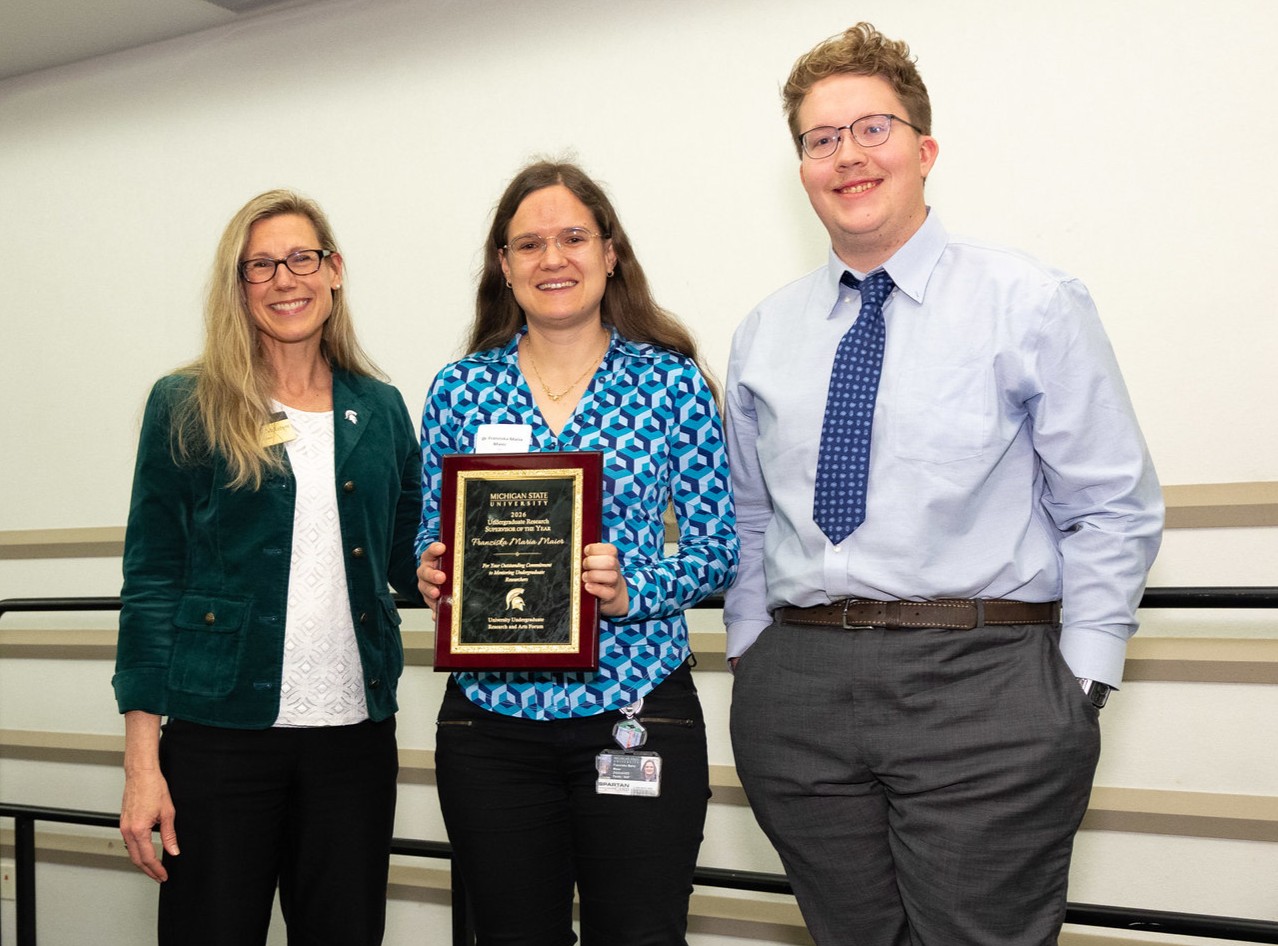
Maier and her colleagues also are developing a next-generation mass separator that will expand the reach of FRIB’s mass measurement program and provide cleaner isotope beams for experiments. The work helps scientists better understand nuclear structure, nuclear astrophysics, and fundamental symmetries, while providing research opportunities for students.
Since January 2024, Maier has directly supervised four undergraduate students and one doctoral student at MSU while also contributing to the training and mentoring of additional students at the FRIB and ISOLDE at CERN, an international nuclear physics research program where she continues to be involved after completion of her doctorate.
She centers her mentorship around an inclusive, supportive and growth-oriented environment that helps students develop confidence, independence and scientific identity. Students receive individual support through weekly one-on-one meetings. They have conversations about future careers, share feedback on manuscripts and prepare research presentations for conferences.
“I aim to help build a research culture in which students from diverse backgrounds can thrive and contribute meaningfully to science and in which questions, curiosity and collaboration are highly valued,” Maier said. “Through both technical training and personal support, I strive to prepare students not only to become strong researchers, but also excellent future mentors and leaders.”
Under Maier’s mentorship, experimentation is encouraged and all ideas are considered seriously. She strives for an atmosphere where students feel comfortable sharing unconventional solutions and exploring new approaches.
“What sets her apart is that she is never a ‘nay-sayer.’ Instead of dismissing suggestions, she treats them as opportunities for investigation,” the student nominator said. “Any idea I bring forward is welcomed, discussed seriously, and explored if it shows promise. This mindset has strengthened my problem-solving skills, encouraged curiosity, and taught me to think creatively within a scientific framework. Her guidance has been essential in shaping my confidence and independence as a developing researcher.”
It is a freedom that has already led to several breakthroughs, according to the nominator.
Maier’s mentorship has directly contributed to student success. One student won a best-poster award at the International Heavy Ion Accelerator Conference in 2025. Another student earned recognition for their work at UURAF, and a third earned the Hantel Fellowship for outstanding undergraduate research. She supported students in writing peer-reviewed manuscripts and served as second author on two student-led publications, and one submitted manuscript.
Maier encourages conference presentations, writes recommendation letters for competitive internships, and helps students connect their research with career goals. The student nominator described Maier as a respected researcher and expert in the field who makes herself accessible to students and supports their research.
Winning the Undergraduate Research Supervisor of the Year Award proved incredibly meaningful for Maier as it is an award based on nominations from her student mentees. The award motivates her to continue involving students in her research, including the future DopCool project at the University of Jyväskylä in Finland, while moving closer to her long-term goal of becoming a professor.
Learn more about undergraduate research at MSU, past award recipients and upcoming research opportunities for students at urca.msu.edu.