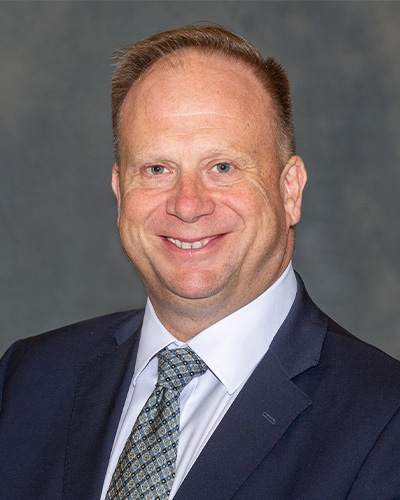
Last month, I had the opportunity to join several dozen Michigan State University students along with several faculty and staff who participated in this year’s spring break offering of International Engagement in Mexico (IEM). Traveling with me was Luis Garcia, the creator and longtime leader of IEM and the director of MSU’s Farmworker Student Services, the unit that houses both IEM and the College Assistance Migrant Program (CAMP). The weeklong trip quickly became a vivid reminder of the power of experiential learning, the importance of community partnerships, and the ways in which education can connect students to a broader world.
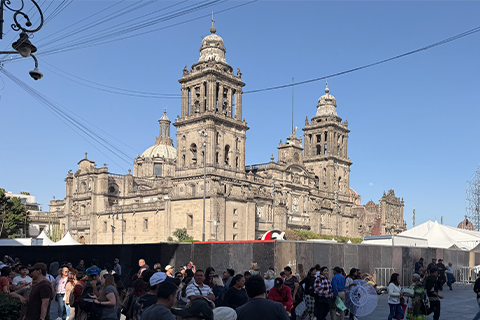
Our journey took us from Michigan to Mexico City and onward to Huatulco and Oaxaca. It was my first time traveling to this part of Mexico, and I found myself continually struck by the richness of the experience. Mexico City’s scale and energy are incredible, especially as one comes to understand the many-layered histories that are visible in its architecture, from ancient pyramids to colonial-era buildings to modern developments. As we moved onto Huatulco and Oaxaca, the pace shifted, and the textures of daily life in smaller communities came into sharper focus. The landscapes were stunning, the cultural traditions deeply rooted, and the sense of place unmistakable.
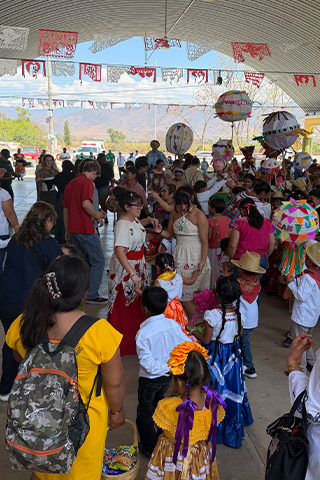
But what made the experience truly transformative was not simply the travel—it was the work. Alongside our students, I spent time in two small rural communities where we partnered with local residents to upgrade kindergarten and elementary school facilities. These were not abstract service projects; they were tangible, hands-on efforts shaped by the needs and priorities of the communities themselves.
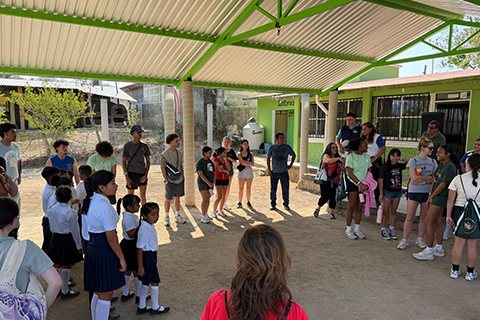
The students worked on painting classrooms, repairing infrastructure, improving learning spaces, and helping to create environments that better support young children’s education. They quickly became friends with the young children in the school. The work was physical and, at times, challenging. But what stood out most to me was how our students approached it with humility, curiosity, and a willingness to learn as much as to contribute.
Experiential learning programs like IEM are powerful precisely because they ask students to engage in learning differently than is the traditional norm for college students. They move beyond the classroom and into contexts that require adaptability, collaboration, and reflection. Students are not just absorbing information; they are navigating unfamiliar environments, building relationships across language and cultural differences, and confronting real-world complexities. These are the kinds of experiences that shape how students understand their role in the world.
Throughout the trip, I was reminded that student success is not only about what happens on our campus. It is also about how we prepare students to engage meaningfully with the broader world. Programs like IEM align closely with our commitment to an institution deficit model of student success because it asks how our structures, opportunities, and supports can better meet students where they are and expand what is possible for them.
Importantly, IEM does not stand alone. It is part of a broader set of efforts led by Farmworker Student Services. The same team that organizes and leads IEM also directs CAMP, creating a powerful continuity between global experiential learning and on-campus student support. That shared leadership is not incidental. It is what allows these programs to be so deeply connected in purpose and impact.
Those connections were evident throughout the IEM experience. Many of the communities we worked in are part of broader migration networks that extend into the United States, including into regions like Michigan. The educational challenges faced by young children in rural Oaxaca, which includes limited resources, infrastructure needs, and economic constraints are part of a larger system that shapes the lives of migrant families.
CAMP helps support students who are navigating higher education within that same broader context. Seeing this continuum firsthand reinforces why programs like CAMP are so essential. They are not simply support programs; they are part of a larger ecosystem of opportunity that spans borders and generations. The same commitment to meeting students where they are, valuing their lived experiences, and building structures that support their success is present in both IEM and CAMP.
That sense of connection was reinforced for me just days after returning from Mexico. On Sunday, March 22, I had the opportunity to reconnect with many of the staff and students from CAMP at the Soft Jazz, Warm Hearts Concert fundraiser hosted by the University United Methodist Church. What struck me most in that moment was how seamlessly the experiences from the IEM trip carried forward into that space. The concert was not just about music, just as IEM was not simply about painting classrooms or repairing school buildings. We were building a network of support that sustains students as they pursue their degrees by deepening students’ relationships with the larger community.
The CAMP students who spoke at the event embody many of the same qualities I saw in our IEM participants, including determination, adaptability, and a strong sense of purpose. Their journeys to MSU have been shaped by significant challenges, but also by deep strengths rooted in family, community, and lived experience. CAMP plays a critical role in ensuring that those strengths are recognized, supported, and leveraged to empower these amazing students.
For me, the IEM trip was a powerful reminder of why this work matters. It is easy, in the day-to-day responsibilities of administration, to become focused on policies, programs, and metrics. Those are important. Experiences like these bring us back to the human dimension of our work, the relationships, the communities, and the individual students whose lives are shaped by the opportunities we create and support.
As we continue to advance MSU’s student success strategy, programs like IEM and CAMP must be understood as central to our mission. They challenge us to think differently about education, to build bridges across contexts, and to ensure that all students, regardless of their starting point, deserve all the support they need to learn, thrive, and graduate.
I am grateful to Luis Garcia and the entire Farmworker Student Services team, as well as the students and staff who made the IEM experience possible and the CAMP community for the work they do every day. Together, they represent the best of what MSU can be: an institution committed not only to education, but to engagement, equity, and impact.